The solution to road congestion in Singapore (indeed, anywhere in the world) is simple. Decide on a maximum number of vehicles allowed which will result in smooth flowing traffic and NEVER raise it once that number of vehicles is reached. Any new vehicles thereafter will only be on the basis of a one-for-one replacement ie: one old vehicle taken off the road for one new vehicle on the road.
All it takes to make this work is to DISALLOW private individual ownership of cars. If we are to model road traffic with our blood circulatory system, the rationale for this becomes abundantly clear and sensible. We don't have blood that is specific for the heart, specific for the liver or specific for the brain etc... All our organs share the SAME pool of blood. Any other model would make our circulatory system so complex and inefficient that we would not be able to exist.
The common pool of cars will be available to anyone to use provided they have a valid drivers licence. In essence, this will be a shared car scheme extended to all vehicles nationwide. It has to be so, for the scheme to be workable (a bit like GST being implemented across the board). Current shared car schemes are too small in scope eg: you have to book or reserve your use beforehand and this is a big negative since the main attraction of car ownership is the freedom to use it as and when you like.
The cost of using cars in such a scheme should be less than what you would be charged if you took a taxi for the trip. The drivers licence could also function as an ez-link type card (to be inserted into the in-vehicle unit or the car won't start). The freedom that comes from being able to hop into any available car anywhere and driving it to your destination and then leaving it (when it will then become available for anyone else to use) will far outweigh the hassle of ownership of your own vehicle. As a side effect, it will also remove cars from functioning as a social status symbol, removing yet another irritant and levelling out the social playing field.
On the revenue side, the government need not fret. Instead of individuals bidding for the COE, it will be companies operating these fleets of sharable cars that will be bidding for them. If they want to increase their market share of the business, they will bid for more COEs. ERP charges will still be in play to reduce traffic congestion from specific areas and these will be paid for by the drivers. There will however, no longer be any parking charges. Implementation of this scheme can be phased in over a period of 10 years, time to allow for current privately owned COEs to expire.
Would this scheme be popular? Obviously not. Would Dr Goh Keng Swee have implemented it? I think he would. As the man who made the 'wildly popular' NS scheme a conerstone of our nation building, this should be a cinch :)
Would Transport Miniser Lui Tuck Yew (or for that matter, any of the current cabinet ministers) even consider putting such a scheme on the table? I'm not so sure. And that is a problem. We just don't have any visionary leaders now or at least, we're are waiting with bated breath for one to appear...
To decisively solve this transportation conundrum, we need to divorce ourselves from the 'romance' of owning our cars and boil it down to its essential purpose: a car is just an utility that merely provides a convenient means of transport. One that we can STILL enjoy without ownership. We just need a leader courageous enough to step up to the plate and make it so.
Tuesday, 4 October 2011


Saturday, 17 September 2011
The Leaning Lamp Post of Singapore
Tower of Pisa it is not. This newly installed street lamp post has been leaning precariously for at least the past week when I first noticed it. I am highlighting this because it is an issue that has been bugging me for a while.

A while back, a car was crushed by a falling tree during a storm and the driver unfortunately lost his life. The authorities then embarked on a tree trimming rampage. I do not know if this was done with the intention of appearing pro-active given that the general elections was then not far off.
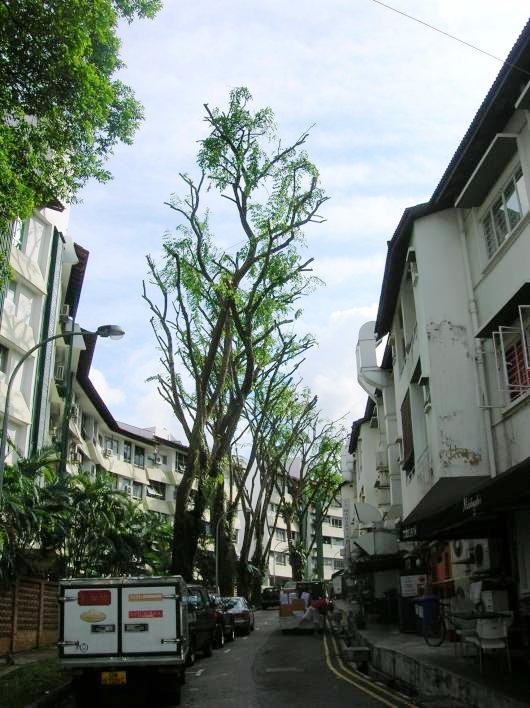
Since then, it is a common sight to see road crews going around trimming trees to such an extent that they are shorn almost bald. Sidewalks that used to be shaded from the sun are now exposed to the full glare of the sun. Roads which used to be green cool tunnels with tree branches arcing over from both sides of the road and meeting in the middle are now transformed into hot tarmac shimmering in the heat.

But if you will remember, a few years back, a schoolboy was killed by a falling lamp post. However, I didn't notice the authorities embarking on a lamp post checking frenzy :) In fact, for the entirety of my life when travelling along our roads, I've never had the privilege of EVER seeing a crew inspecting a lamp post. So, why the difference in reaction between an accident caused by a tree (an act of nature) and the one caused by a man made object (man's fault by poor maintenance)? Anyone?
Given that the probability of someone being killed by a falling tree or branch (one in ten years?) is far more unlikely than someone striking the lottery (usually at least one person a week) I would suggest that the authorities instead award the family of the unfortunate victim of a tree accident a million dollars, sponsored by Singapore Pools instead of going around vandalising our trees. The million dollars would serve to meet the family's financial needs a lot more than some grand gesture (or publicity stunt) of going around trimming trees which may or may not be posing a clear and present danger.

In the meantime, a lamp post is still leaning precariously somewhere in Singapore. If the authorities can only see past the trees, perhaps they will spot it. Hopefully by next week it will be fixed!

A while back, a car was crushed by a falling tree during a storm and the driver unfortunately lost his life. The authorities then embarked on a tree trimming rampage. I do not know if this was done with the intention of appearing pro-active given that the general elections was then not far off.
Since then, it is a common sight to see road crews going around trimming trees to such an extent that they are shorn almost bald. Sidewalks that used to be shaded from the sun are now exposed to the full glare of the sun. Roads which used to be green cool tunnels with tree branches arcing over from both sides of the road and meeting in the middle are now transformed into hot tarmac shimmering in the heat.
But if you will remember, a few years back, a schoolboy was killed by a falling lamp post. However, I didn't notice the authorities embarking on a lamp post checking frenzy :) In fact, for the entirety of my life when travelling along our roads, I've never had the privilege of EVER seeing a crew inspecting a lamp post. So, why the difference in reaction between an accident caused by a tree (an act of nature) and the one caused by a man made object (man's fault by poor maintenance)? Anyone?
Given that the probability of someone being killed by a falling tree or branch (one in ten years?) is far more unlikely than someone striking the lottery (usually at least one person a week) I would suggest that the authorities instead award the family of the unfortunate victim of a tree accident a million dollars, sponsored by Singapore Pools instead of going around vandalising our trees. The million dollars would serve to meet the family's financial needs a lot more than some grand gesture (or publicity stunt) of going around trimming trees which may or may not be posing a clear and present danger.

In the meantime, a lamp post is still leaning precariously somewhere in Singapore. If the authorities can only see past the trees, perhaps they will spot it. Hopefully by next week it will be fixed!
Sunday, 11 September 2011
The Little Sampan That Is Singapore Is Sinking
By design. Imagine if you will, a boat that is built with holes drilled in its bottom. The only way for the occupants of the boat to keep afloat is to keep bailing out the water that seeps in. It's the same for every country actually. Bailing out the water from the boat is a metaphor for economic activity. Nobody owes us or anyone else for that matter, a living. We have to make ourselves useful and relevant to the global economic system to survive as a modern society.
To that end, we have to build the necessary infrastructure as the foundation and put in place policies that will put that infrastructure to good use eg: a good education system and sensible policies that encourage and make it easy for business and industry to set up here and hence generate employment.
In Singapore's case, we have become a victim of our own success. With everything chugging along nicely with visible improvements year by year, we just plain got greedy. From bailing out the water to keep the boat from sinking to keeping our feet dry, we have proceeded along the path where the governments' seeming ambition is to bail out the water so fast that the boat will actually levitate out of the water! It is against the laws of physics or in our metaphorical case: the physical limits of our country and the resources available to us makes it impossible.
With improving living standards and the concomitant rise in the cost of living, Singaporeans' expectations of what they want to do and how much they want to earn would naturally rise in tandem. This would lead to a rise in the cost of doing business and a drop in productivity and hence GDP. The governments 'solution' is
to allow in foreign workers, first to do jobs that Singaporeans shun because they do not pay well enough and then to keep wage costs down so as to artificially boost productivity and GDP. Easy availability of cheaper foreign labour provides downward pressure on wage costs and serves as a natural cap on what Singaporeans can expect in terms of higher wages. Even better, the government is shielded from blame as Singaporeans will first blame employers rather than the government for this. (This is changing though.)
This trick worked so well for a while that the government started building multiple decks on our little boat to accomodate the influx of foreign workers to 'help' with bailing out the water. From the Singaporean workers' perspective, this 'help' is no help at all. Has their work-life balance improved? Are they earning more or having more time to spend with their families because the foreign workers have taken some of the workload off their hands? NO. The foreign workers as it turns out are just bailing out fast enough to carry their own weight. Worse, they are taking up space and possibly stinking up the boat :) The Singaporean worker does not see a line item in their payslip that says that that amount extra is due to some foreign workers' contribution. The government however gets exactly that from the foreign workers levy. Worse, the Singaporean worker is being threatened by their employers to work even harder just to KEEP their jobs.
There are several category 6 typhoons or hurricanes swirling around the globe at the moment. Our multi-decked little sampan is top heavy and not rated for heavy seas. It would not take much for it to capsize. Should we start lightening the load on our boat now while we still have time to pick and choose or wait until the last
possible moment when we are swamped and panicking with bedlam and chaos reigning on deck? That is when the proverbial baby gets tossed out with the bath water. The Captain of our little sampan fancies himself a Captain of a little ship. What do you think?
To that end, we have to build the necessary infrastructure as the foundation and put in place policies that will put that infrastructure to good use eg: a good education system and sensible policies that encourage and make it easy for business and industry to set up here and hence generate employment.
In Singapore's case, we have become a victim of our own success. With everything chugging along nicely with visible improvements year by year, we just plain got greedy. From bailing out the water to keep the boat from sinking to keeping our feet dry, we have proceeded along the path where the governments' seeming ambition is to bail out the water so fast that the boat will actually levitate out of the water! It is against the laws of physics or in our metaphorical case: the physical limits of our country and the resources available to us makes it impossible.
With improving living standards and the concomitant rise in the cost of living, Singaporeans' expectations of what they want to do and how much they want to earn would naturally rise in tandem. This would lead to a rise in the cost of doing business and a drop in productivity and hence GDP. The governments 'solution' is
to allow in foreign workers, first to do jobs that Singaporeans shun because they do not pay well enough and then to keep wage costs down so as to artificially boost productivity and GDP. Easy availability of cheaper foreign labour provides downward pressure on wage costs and serves as a natural cap on what Singaporeans can expect in terms of higher wages. Even better, the government is shielded from blame as Singaporeans will first blame employers rather than the government for this. (This is changing though.)
This trick worked so well for a while that the government started building multiple decks on our little boat to accomodate the influx of foreign workers to 'help' with bailing out the water. From the Singaporean workers' perspective, this 'help' is no help at all. Has their work-life balance improved? Are they earning more or having more time to spend with their families because the foreign workers have taken some of the workload off their hands? NO. The foreign workers as it turns out are just bailing out fast enough to carry their own weight. Worse, they are taking up space and possibly stinking up the boat :) The Singaporean worker does not see a line item in their payslip that says that that amount extra is due to some foreign workers' contribution. The government however gets exactly that from the foreign workers levy. Worse, the Singaporean worker is being threatened by their employers to work even harder just to KEEP their jobs.
There are several category 6 typhoons or hurricanes swirling around the globe at the moment. Our multi-decked little sampan is top heavy and not rated for heavy seas. It would not take much for it to capsize. Should we start lightening the load on our boat now while we still have time to pick and choose or wait until the last
possible moment when we are swamped and panicking with bedlam and chaos reigning on deck? That is when the proverbial baby gets tossed out with the bath water. The Captain of our little sampan fancies himself a Captain of a little ship. What do you think?
Tuesday, 30 August 2011
To Be or Not to Be Populist
That is the conundrum facing the government after the results of the recent Presidential election showed that the government's choice of candidate was 'decisively' elected by a margin of less than 0.5 percent. Coming from the former Chairman of the GIC, it does give pause for thought when one recalls in the past that the GIC had re-assured Singaporeans that the funds it manages are safe and indeed have managed 'respectable' returns when compared with other privately managed investment/hedge funds in the market. One would suggest a very large helping of salt and a healthy dose of skepticism the next time the President offers to give an opinion :)

But I digress. The government, I'm guessing is now debating whether to go all in to sweeten the ground and bolster its chances of maintaining its electoral wins come the next general election or to stay the course, ie: business as usual. Neither of these is palatable. The correct course of action is to do the right thing. But when I see headlines like this (see picture ↑), I wonder. The first thing that came to my mind was: 'Wow! Four years .... just in time for the next election. How convenient!'
I'm sorry Mr Khaw, but the housing problem won't be solved in 4 years (short of a world war, famine or outbreak of exotic strains of flu). I wish that were the case, but both you and I know it's just a stop gap measure to a growing problem. You know, like by encouraging people to have more babies and opening the floodgates to immigration. But then it's 2012 next year and the Mayans may well be proven correct and all of these problems will just go away because most of us won't be around anymore.
Populist measures are unsustainable and limited in its effect. You can no more cure a disease by treating the symptoms than you can get rid of lalang by cutting it. You have to get to the root of the issue. Hopefully, this isn't how the government is going to address all the challenges it faces. It gives the impression of a fair
weather government over-reacting at its first experience of turbulence. Not good at all for our collective future.

But I digress. The government, I'm guessing is now debating whether to go all in to sweeten the ground and bolster its chances of maintaining its electoral wins come the next general election or to stay the course, ie: business as usual. Neither of these is palatable. The correct course of action is to do the right thing. But when I see headlines like this (see picture ↑), I wonder. The first thing that came to my mind was: 'Wow! Four years .... just in time for the next election. How convenient!'
I'm sorry Mr Khaw, but the housing problem won't be solved in 4 years (short of a world war, famine or outbreak of exotic strains of flu). I wish that were the case, but both you and I know it's just a stop gap measure to a growing problem. You know, like by encouraging people to have more babies and opening the floodgates to immigration. But then it's 2012 next year and the Mayans may well be proven correct and all of these problems will just go away because most of us won't be around anymore.
Populist measures are unsustainable and limited in its effect. You can no more cure a disease by treating the symptoms than you can get rid of lalang by cutting it. You have to get to the root of the issue. Hopefully, this isn't how the government is going to address all the challenges it faces. It gives the impression of a fair
weather government over-reacting at its first experience of turbulence. Not good at all for our collective future.
Thursday, 25 August 2011
The Four Horsemen of the Presidential Election
For the first time in Singapore, a presidential election is being contested by four eligible candidates. Also for the first time, the government has not openly endorsed a particular candidate. In the past when there was no contest, the presidential candidate was effectively appointed by the government. I do not think President Nathan put himself up for the post of president on his own initiative.
The fact that the government has chosen not to openly endorse a candidate this time speaks volumes on how the balance of power has shifted after the recent general election. An open endorsement from the government is no longer considered a plus and may well count against that particular candidate.
Nevertheless, one candidate has been 'strongly recommended'. One after another various organisations closely affiliated to the government have come out endorsing that particular candidate. This is government endorsement by proxy. The fact the government has chosen to act so coy on such a matter does not bode well for future transparency and openess on other matters of perhaps more immediate concern and effect on citizens.
If one analyses the results of the general election and the loss of a GRC to the opposition, one can conclude that there is still a sizeable segment of the electorate who is rational enough to elect the incumbent party's team if the oppositon party's team is judged to be not up to standard. Hence, George Yeo unfortunately lost his seat while other more 'deserving' to lose ministers managed
to keep theirs.
In the months leading up to this election, several ministers have come forward to emphasise the limitations of the Presidents' role and powers. This downplaying of the role of the presidency may well backfire on the government. The rational segment of the electorate may now decide to elect a candidate that is NOT the government's obvious choice since the consequences if any, are negligible
given the Presidents apparent limitations.
Of the four candidates, Dr Tony Tan has the widest range of experience and expertise. His campaign platform emphasis has been on the importance of safeguarding the national reserves. But as Chairman of the GIC, he has direct executive powers on how those reserves are to be deployed and he can do this without government interference, as least that is what foreign governments have been told. As President, he can only act as the gatekeeper, a relatively minor role. So, Dr Tony Tan can best achive his stated objectives by remaining as Chairman of the GIC. Had a reluctant George Yeo decided to throw his hat into the ring, Dr Tony Tan will likely have stayed put at GIC.
Dr Tan Cheng Bock has come out, in my opinion, as the candidate with the least clearly defined idea of what he wants to do as president. His two stated objectives came right out of left field. Multi-culturalism? I did not realise that there were racial or cultural problems in Singapore that needed presidential attention at the moment. Separation of the Presidential and Prime Ministers' office? Was that ever an issue with the electorate?
Mr Tan Jee Say appears to be the candidate most passionate about what he wants to achieve as the President. Even if what he wants to do may lie outside the ambit of presidential powers as defined by the constitution. He is also the candidate if elected, most likely to make the PM voluntarily vacate his Istana's office just to escape from his friendly drop-by chats :) He wants to unify a 'divided' Singaporean electorate. I think it is important to distinguish and differentiate between a country and its government. They are separate entities. Voting for the opposition does not make you disloyal to your country. So, there is no disunity in my mind to unite.
Mr Tan Kin Lian is most easily and comfortably identified with the 'common' Singaporean. He found 'religion' once he left his position as CEO of NTUC Income. By religion, I mean he began to speak out and write against the practices of his former insurance industry, among other things. He professes to want to make the lives of Singaporeans better but given the largely ceremonial and custodial nature of the Presidency, it is difficult to see how that can be achieved.
Personally, I feel that since the custodial function of the president is the reason why we have an elected president in the first place, it would be good to have a pair of eyes from outside of the government establishment to be the watchdog. If the recent and ongoing financial crisis has ANY lessons for us, it is that when financial organisations (of which GIC and Temasek Holdings are examples) have the freedom to hide or obfuscate their dealings, they WILL stray to the dark side.
Whoever gets elected as president this weekend, I'm sure he can call and rely upon the other three for any assistance if asked. The government of the day should be aware that the President is elected by the WHOLE of Singapore, not just an electoral constituency and should accord him the proper respect.
The fact that the government has chosen not to openly endorse a candidate this time speaks volumes on how the balance of power has shifted after the recent general election. An open endorsement from the government is no longer considered a plus and may well count against that particular candidate.
Nevertheless, one candidate has been 'strongly recommended'. One after another various organisations closely affiliated to the government have come out endorsing that particular candidate. This is government endorsement by proxy. The fact the government has chosen to act so coy on such a matter does not bode well for future transparency and openess on other matters of perhaps more immediate concern and effect on citizens.
If one analyses the results of the general election and the loss of a GRC to the opposition, one can conclude that there is still a sizeable segment of the electorate who is rational enough to elect the incumbent party's team if the oppositon party's team is judged to be not up to standard. Hence, George Yeo unfortunately lost his seat while other more 'deserving' to lose ministers managed
to keep theirs.
In the months leading up to this election, several ministers have come forward to emphasise the limitations of the Presidents' role and powers. This downplaying of the role of the presidency may well backfire on the government. The rational segment of the electorate may now decide to elect a candidate that is NOT the government's obvious choice since the consequences if any, are negligible
given the Presidents apparent limitations.
Of the four candidates, Dr Tony Tan has the widest range of experience and expertise. His campaign platform emphasis has been on the importance of safeguarding the national reserves. But as Chairman of the GIC, he has direct executive powers on how those reserves are to be deployed and he can do this without government interference, as least that is what foreign governments have been told. As President, he can only act as the gatekeeper, a relatively minor role. So, Dr Tony Tan can best achive his stated objectives by remaining as Chairman of the GIC. Had a reluctant George Yeo decided to throw his hat into the ring, Dr Tony Tan will likely have stayed put at GIC.
Dr Tan Cheng Bock has come out, in my opinion, as the candidate with the least clearly defined idea of what he wants to do as president. His two stated objectives came right out of left field. Multi-culturalism? I did not realise that there were racial or cultural problems in Singapore that needed presidential attention at the moment. Separation of the Presidential and Prime Ministers' office? Was that ever an issue with the electorate?
Mr Tan Jee Say appears to be the candidate most passionate about what he wants to achieve as the President. Even if what he wants to do may lie outside the ambit of presidential powers as defined by the constitution. He is also the candidate if elected, most likely to make the PM voluntarily vacate his Istana's office just to escape from his friendly drop-by chats :) He wants to unify a 'divided' Singaporean electorate. I think it is important to distinguish and differentiate between a country and its government. They are separate entities. Voting for the opposition does not make you disloyal to your country. So, there is no disunity in my mind to unite.
Mr Tan Kin Lian is most easily and comfortably identified with the 'common' Singaporean. He found 'religion' once he left his position as CEO of NTUC Income. By religion, I mean he began to speak out and write against the practices of his former insurance industry, among other things. He professes to want to make the lives of Singaporeans better but given the largely ceremonial and custodial nature of the Presidency, it is difficult to see how that can be achieved.
Personally, I feel that since the custodial function of the president is the reason why we have an elected president in the first place, it would be good to have a pair of eyes from outside of the government establishment to be the watchdog. If the recent and ongoing financial crisis has ANY lessons for us, it is that when financial organisations (of which GIC and Temasek Holdings are examples) have the freedom to hide or obfuscate their dealings, they WILL stray to the dark side.
Whoever gets elected as president this weekend, I'm sure he can call and rely upon the other three for any assistance if asked. The government of the day should be aware that the President is elected by the WHOLE of Singapore, not just an electoral constituency and should accord him the proper respect.
Thursday, 18 August 2011
National Day Rally Speech: An opportunity missed?
Back in the nineties at the dawn of the Internet age when an upstart start up named Netscape looked about to eat Microsoft's lunch with its Netscape Navigator web browser, what did Bill Gates do? He redirected Microsoft's original stand-alone desktop strategy to one which placed the Internet front and center of its new focus and created Microsoft's IE browser. The rest as they say is history....especially for Netscape.
Similarly, Singapore's political landscape is at a crossroads with the landmark loss of a GRC at the recent general election. In this case though, unfortunately PM Lee Hsien Loong did not, in my opinion rise to the occasion and met the challenge as Bill Gates did.
In his speech, he appears to have identified the critical issues faced by his government much like Bill Gates had identified the need to get on the Internet bandwagon. Unfortunately, his speech did not articulate a road map with specific details of how his government would address those issues.
These issues are the result of policies that have been implemented for well over a decade. They are unlikely to be reversed and the effects felt by the ground within the timeframe of the next general election.
For example: "Singaporeans First" makes for a good soundbite, but details are scant of just how it is going to be implemented or enforced. The measures announced to address these issues seem like mere bandaids on a gushing arterial wound.
For example: Raising the income ceiling for HDB flats from $8,000 to $10,000. All it does is to make $10,000 the new threshold for appeals. Increasing university places by 2000? What about the 2001 person that just missed the cut? Increasing subsidies for more drugs and low-income earners? How is this going to be funded? If no additional taxes are going to be levied, then why was this not done before and only now after an election loss? Is the GST going to be raised to a nice round and easy to calculate 10%? In the current and forseeable inflationary environment, good luck with that. The government might as well stand down and let it be an oppositon walkover for the next election :)
I think PM Lee missed the opportunity to make use of the speech to lay out a coherent action plan to address these issues. Without such a plan being articulated there is no way to manage public expectations. The temperature on the ground is still simmering (witness the booing presidential candidate Dr Tony Tan received yesterday). Ad hoc measures like those that Mr Khaw Boon Wan had made in relation to housing issues are not enough. They give an impression of seat-of-the-pants fire-fighting and not of a government knowing what it needs to do and doing it in a coordinated manner. Perhaps we could have a post National Day Rally Speech speech do-over and this time, hopefully do it better :)
Similarly, Singapore's political landscape is at a crossroads with the landmark loss of a GRC at the recent general election. In this case though, unfortunately PM Lee Hsien Loong did not, in my opinion rise to the occasion and met the challenge as Bill Gates did.
In his speech, he appears to have identified the critical issues faced by his government much like Bill Gates had identified the need to get on the Internet bandwagon. Unfortunately, his speech did not articulate a road map with specific details of how his government would address those issues.
These issues are the result of policies that have been implemented for well over a decade. They are unlikely to be reversed and the effects felt by the ground within the timeframe of the next general election.
For example: "Singaporeans First" makes for a good soundbite, but details are scant of just how it is going to be implemented or enforced. The measures announced to address these issues seem like mere bandaids on a gushing arterial wound.
For example: Raising the income ceiling for HDB flats from $8,000 to $10,000. All it does is to make $10,000 the new threshold for appeals. Increasing university places by 2000? What about the 2001 person that just missed the cut? Increasing subsidies for more drugs and low-income earners? How is this going to be funded? If no additional taxes are going to be levied, then why was this not done before and only now after an election loss? Is the GST going to be raised to a nice round and easy to calculate 10%? In the current and forseeable inflationary environment, good luck with that. The government might as well stand down and let it be an oppositon walkover for the next election :)
I think PM Lee missed the opportunity to make use of the speech to lay out a coherent action plan to address these issues. Without such a plan being articulated there is no way to manage public expectations. The temperature on the ground is still simmering (witness the booing presidential candidate Dr Tony Tan received yesterday). Ad hoc measures like those that Mr Khaw Boon Wan had made in relation to housing issues are not enough. They give an impression of seat-of-the-pants fire-fighting and not of a government knowing what it needs to do and doing it in a coordinated manner. Perhaps we could have a post National Day Rally Speech speech do-over and this time, hopefully do it better :)
Saturday, 6 August 2011
All aboard! From KTM tracks to Orchard Route

Much has been written about what to do with the KTM land now that they have reverted to Singapore ownership.Opinions have ranged from nature lovers prefering to leave it alone as a nature area to property investors whowant it developed it for 'growth, progress and prosperity for our nation'. My opinion falls nearer to the side of the nature lovers. Let's consider the following pertinent points:
- Malaysia had played hardball for over 20 years on this issue. They could have continued to play hardball for another 20. And if they did, what could we have done? Nothing.
- So any development plans that we might have for the now unencumbered KTM land is purely discretionary. Our economic well-being isn't tied to it. If it is, then we are indeed in deep trouble and our troubles won't be solved by developing the KTM land, only delayed at best. Consider if point 1 above had come to pass.
the monotony was broken in parts only by the sighting of a few scattered fruit trees, principally durian, rambutan and the odd occasional 'farm'.
And this observation is what leads to my suggestion. Why not enhance the KTM tracks by planting fruit and food trees all along the way so that it becomes an 'Orchard Route'? This is an obvious play on Orchard Road which is a major tourism destination. Someone in the past had a brainwave and came up with the Night Safari attraction. I'm sure with a little more thought and imagination, this suggestion of an Orchard Route could have a similar impact.
Indulge me and just imagine for a moment: A long avenue where tropical fruits and food plants from all over the world are planted. Avocado, cashew, jambu, petai to name a very few...how many of you have seen such fruits growing on trees? Or the kind of bamboo whose leaves are used to wrap dumplings? Japan has its avenues of cherry trees famous for their spring flowering. We could have a long green corridor that is flowering and fruiting all YEAR round as the variety of fruits come into season. An ongoing spectacle not just for tourism but also I feel, an educational resource for guided field trips for school children as well.
The cost of enhancing such a green corridor could mostly be subsidised by the public and corporate entities. For corporations, it could be an additional avenue for them to offset their carbon footprint. For the public which is increasingly concerned about environmental issues as evidenced by their keen response to this KTM land issue, they could help by sponsoring the planting of trees like the tree planting program currently undertaken by NParks. See here: http://www.gardencityfund.org/pat/. By allowing the public to decide what type of trees they want to sponsor as well as marketing it as a green way to mark special occasions eg: the birth of their child, the response could be good enough that the project could well end up being self funding.
In enhancing the green corridor, we should not lose sight that it is not just for people alone. It is a vital highway for our much diminished wildlife to disperse and maintain genetic diversity. It is also important to maintain its 'untidy' cover of undergrowth which provides both food and habitat for wildlife. Its very untidyness is one of its charms. Those who crave neatly manicured lawns and sanitised environments can keep to the usual HDB heartland parks, playgrounds and the Botanic Gardens.
For the bean counters out there, can we put a monetary value on leaving the KTM land as a connected green corridor? Yes, very easily actually. Consider the recently announced plan to build the ecolink to re-link the separated halves of the Bukit Timah Nature reserve. What would be the cost to create an equivalent length of connected land spanning say from the west to the east of Singapore? The roads that have to be closed or bridged over. The buildings that have to be demolished to make way. And there you would have it. I don't think it would be a small sum.
The government has announced that they will be taking two years to decide the fate of the KTM land. I'm being cynical here but I believe most of that time will be spent on deciding how to divide up the land into development plots and the PR spin to manage the public fallout. In the end, likely just a few disconnected patches will be left. as a compromise which serves little purpose as each patch is likely too small to be viable to sustain wildlife of any significance or preserve its intrinsic value of connectedness that allows wildlife to disperse without ending up as roadkill. I hope I'm wrong.
But before any decision becomes cast in stone, please consider this: Breaking up the connectivity of the KTM track land is easy to do and once done, effectively becomes irrevocable. Keeping it connected and enhanced as suggested above as a green fruitful corridor which benefits both people and wildlife is a decision that can be revised if need be (hopefully not), at any time in the future.
Subscribe to:
Posts (Atom)